
an in-depth study of Scream
By Levi Jacobson
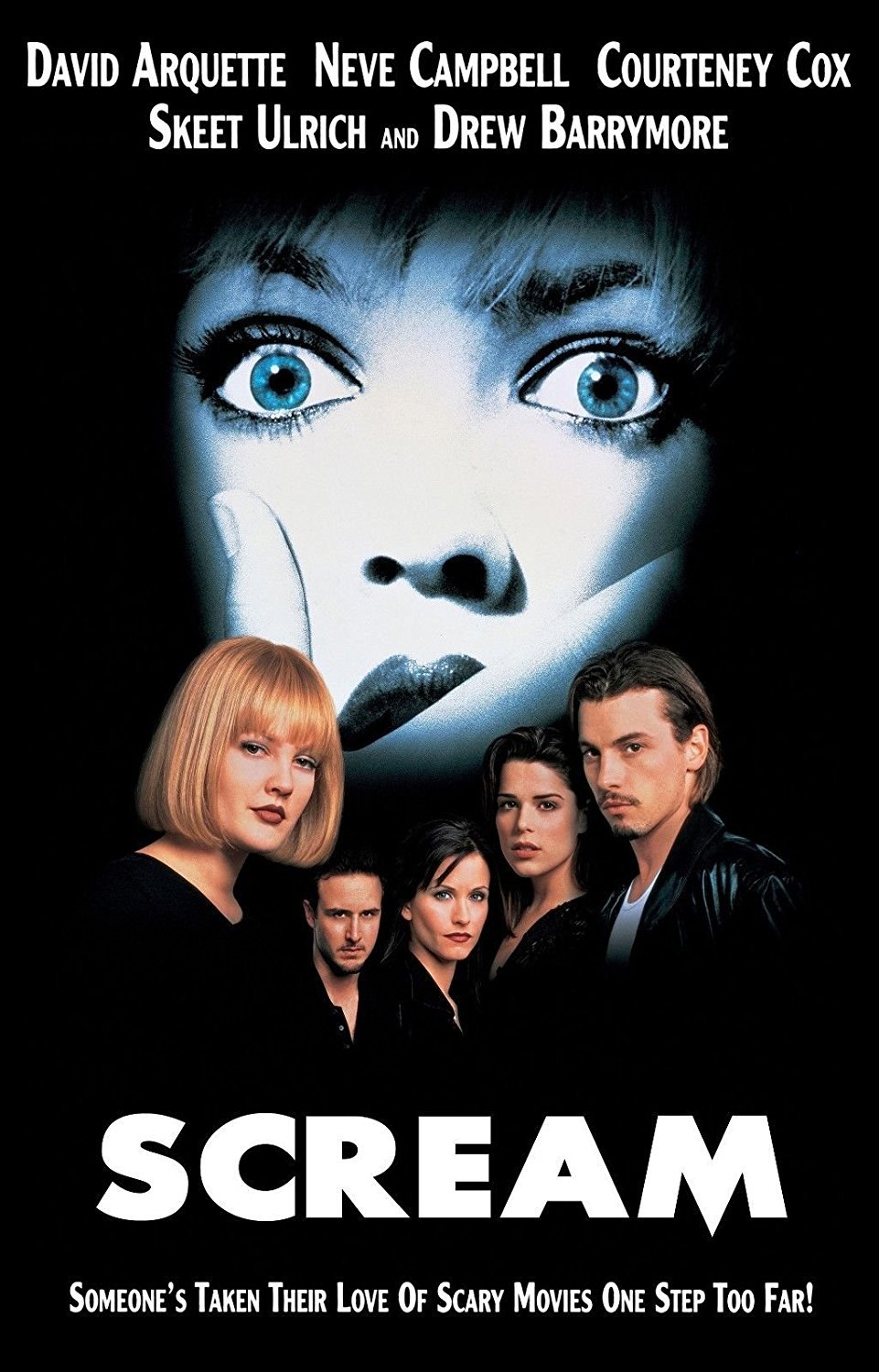
“Not in my movie” is one of the most famous lines from one of the most famous horror franchises in cinema history. The seminal slasher film opens with a scene that redefines horror itself. Every trailer and poster promoting the film shows images of the actress Drew Barrymore, and the movie begins with her answering the phone. The audience expects her to be the “final girl” – the main character in a horror movie who confronts the killer and saves the day, but in Scream, Barrymore is disemboweled and hung from a tree in the first ten minutes. This is unexpected because it is very brutal and we are shocked that Barrymore doesn’t survive the first scene. This is one of the ways the movie tells us it is going to revolutionize the genre. Everything you need to know about the franchise – except the killer – is in this first scene. There is a murderer with a ghost mask and cloak who calls people, harasses them with trivia about the horror genre, and then kills them in a self-referential fashion. The Scream franchise – except Scream 3 – is a masterpiece because it blends true horror with amazing self-referential humor.
Each installment of the franchise adds to the web of meta-textual commentary. Scream 1 talks about how the horror genre is oversaturated and old, and, in so doing, it reinvents the horror genre. It argues that horror movies should be funny, hip, and most importantly meta. Scream 2 talks how “sequels suck!” and never get close to the brilliance of their predecessors. Indeed the film is full of flaws. For example, some scenes are superfluous and the killers don’t make sense. The film was rushed and way too long; however, these flaws build up and end up helping the film’s argument. Scream 3 attempts to investigate how the last installment of a trilogy goes back to the original movie and retcons important parts of the film, undermining character details that create inconsistencies in the overall storyline. In Scream 4, the franchize is redeemed. This installment comments on how bad reboots are, yet it is a great film because it returns to its roots by having the killers try to remake the original.
Scream 1 follows a town that has been terrified by a rash of killings. It follows final girl Sydney Presscot who has been tortured by the memory and trauma of her mother’s death and the murder of her friends. The cast of characters includes her father, her boyfriend Billy, Her best friend Tatum, Her friend Stu, local news reporter Gale Weathers and bumbling Deputy Dewey. No one knows the killer’s identity and the killer is fixated on Sydney. As the stakes get higher and people drop like flies, a curfew is enforced. Town Goofball Stu Macher decides to throw a huge party in his gothic mansion where the third act unfolds. After the news of the principal’s death, half the party leaves out of morbid curiosity. After this, a full-on killing spree ensues. There seem to be four suspects: Sydney’s boyfriend Billy Loomis, Stu Macher, Sydney’s Father and Randy Meeks. The audience expects the killer to be one of these four Suspects. We are shocked to find that it’s not only one killer but two. Both Billy and Stu worked together to kill all those people. The movie ends with the sun rising as Gale reports and tells the story as the camera zooms out and displays that gothic mansion.
It’s an excellent film that’s truly frightening, but what makes this movie so special is its inclusion of meta-commentary. Meta-commentary is the art of referencing a medium whilst working within that medium. One way meta-commentary functions is when a film acknowledges the tropes of the genre it is operating in. Old Horror Films have a distinct and stand out way of being filmed and edited. It’s very choppy and shaky because most of them were made by amateurs. The way they were edited is very back and forth and the effect seems unintentional. Wes Craven consciously directs scenes as if they were from a low-budget slasher film. Likewise the writing comments on seminal films like the original “Friday The 13th” and their poor writing. Kevin Williamson writes a script that calls upon all of these cliches and ends up making a truly original cinematic experience. Some of the classic horror tropes he plays with are:
- The Final Girl
- The unkillable Killer who rises again
- The primal knife-like weapon
- Safety in numbers dangerous when splitting up
- The Big House/Haunted house
- Exhilarating chase scenes
- Surprise twist ending
As we have seen the film uses all of these motifs to honor a “Low brow” Genre and elevate it to a new level of cinematic art.
One of the most iconically meta parts of this film is Randy’s “Rules for Surviving a Horror Movie.”™
- Never have sex
- Never drink or do drugs
- Never say “I’ll be right back”
Immediately Stu–who turns out to be one of the killers–stands up and announces, “I’m getting another beer. Do you want one… I’LL BE RIGHT BACK.” This is one of the best scenes of the movie and perfectly demonstrates the meta-commentary at work in the script.
Other classic examples include the same painting within that painting, a story-within-a-story and of course a movie inside of a movie. There is a mind-boggling level of meta-commentary in the scene “Jamie look behind you.” Randy, played by Jamie Kennedy, talks to a TV playing the horror film HALLOWEEN. He tries to warn Laurie Strode, played by Jamie Lee Curtis, about the killer being behind her. Meanwhile at the same time that he is saying “Jamie look behind you. Jamie turn around,” Ghostface is right behind him with a knife-raised about to kill him. These layers of meta-commentary are pushed to the extreme when you realize that actor who plays Randy’s name is Jamie; thus he is warning himself without realizing the killer is behind him. Thinking about how Kevin Williamson wrote the scene shows the pure genius of this self-referential masterpiece.
At first glance, Randy Meeks may seem like a minor character, but when analyzing further, we can see that he plays two essential roles: 1) he serves as a foil character to Billy and 2) he symbolizes the audience in the situation.
Randy and Billy are foil characters meaning they are complete opposites of each other. Randy likes Sydney and Billy is Sydney’s boyfriend, and this alone sets them in conflict. Randy uses self-referential humor to save people and on the other side of the coin, Billy kills people with wit. Randy is the suspect, Billy is the Killer. Randy is the unpopular film buff and Billy is the cool oily guy most people are friends with. Randy has a Geeky vibe about him. Billy has an uncomfortable yet charming way about him. This means Randy might react to a situation differently to Billy. They act very differently from one another, Randy is calm in an “I got this under control” way, and Billy is calm in a psychotic terrifying way. This is why Randy is the subjectively best character in the series! The character Randy also plays an essential role in this film. He plays the role of the audience – he’s thinking what the audience is thinking and verbalizes it as he watches the horror unfold. In movies, the audience is its own character. in comedy, without the audience laughing it’s not a comedy. In horror, if the audience isn’t scared the effect of the horror is not accomplished. Aware of this, Kevin Williamson wrote Randy as a film buff – he knows the “Rules” of the genre and like him, the audience is aware of how not to die. The script has so many twists and turns and the audience is in a state of shock when the killer is revealed. In that sequence, Randy gets shot and you think he’s dead. At this moment, the audience is taken aback and can no longer follow the “Rules.” At this moment, it seems like Randy has been written out of the story, but when Randy’s “Rules” come back into effect when the killer rises again, Randy also rises. His authority comes back, and he warns Sydney about what is going to happen next. In this sense, the audience can relate with Randy because the audience also understands that this trope will reinforce itself.
Randy warns, “Careful this is the moment where the supposedly dead killer comes back to life for one last scare.” At this moment, Billy snaps back to life, but Sydney quickly fires the last round into Billy’s head. After this Sydney delivers one of cinema’s most iconic line: “Not in my movie.”
© Levi Jacobson with editorial support by Christine Gardiner

 Levi Jacobson Reviews