By Levi Jacobson
Today is my Birthday. My present to you and to myself is to publish the whole investigation of the Scream franchise. It is long, but please read to the end. I mean c’mon its my Birthday!
“Not in my movie”
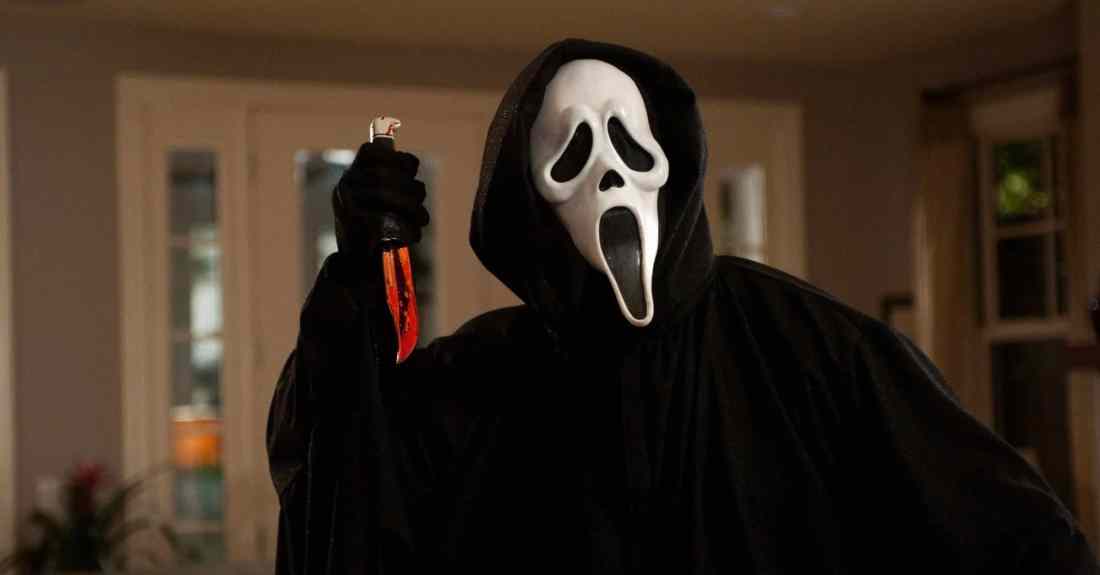
“Not in my movie” is one of the most famous lines from one of the most famous horror franchises in cinema history. The seminal slasher film opens with a scene that redefines horror itself. Every trailer and poster promoting the film shows images of the actress Drew Barrymore, and the movie begins with her answering the phone. The audience expects her to be the “final girl” – the main character in a horror movie who confronts the killer and saves the day, but in Scream, Barrymore is disemboweled and hung from a tree in the first ten minutes. This is unexpected because it is very brutal and we are shocked that Barrymore doesn’t survive the first scene. This is one of the ways the movie tells us it is going to revolutionize the genre. Everything you need to know about the franchise – except the killer – is in this first scene. There is a murderer with a ghost mask and cloak who calls people, harasses them with trivia about the horror genre, and then kills them in a self-referential fashion. The Scream franchise – except Scream 3 – is a masterpiece because it blends true horror with amazing self-referential humor.
Each installment of the franchise adds to the web of meta-textual commentary. Scream 1 talks about how the horror genre is oversaturated and old, and, in so doing, it reinvents the horror genre. It argues that horror movies should be funny, hip, and most importantly meta. Scream 2 talks how “sequels suck!” and never get close to the brilliance of their predecessors. Indeed the film is full of flaws. For example, some scenes are superfluous and the killers don’t make sense. The film was rushed and way too long; however, these flaws build up and end up helping the film’s argument. Scream 3 attempts to investigate how the last installment of a trilogy goes back to the original movie and retcons important parts of the film, undermining character details that create inconsistencies in the overall storyline. In Scream 4, the franchize is redeemed. This installment comments on how bad reboots are, yet it is a great film because it returns to its roots by having the killers try to remake the original.
Scream 1 follows a town that has been terrified by a rash of killings. It follows final girl Sydney Presscot who has been tortured by the memory and trauma of her mother’s death and the murder of her friends. The cast of characters includes her father, her boyfriend Billy, He best friend Tatum, Her friend Stu, local news reporter Gale Weathers and bumbling Deputy Dewey. No one knows the killer’s identity and the killer is fixated on Sydney. As the stakes get higher and people drop like flies, a curfew is enforced. Town Goofball Stu Macher decides to throw a huge party in his gothic mansion where the third act unfolds. After the news of the principal’s death, half the party leaves out of morbid curiosity. After this, a full-on killing spree ensues. There seem to be four suspects: Sydney’s boyfriend Billy Loomis, Stu Macher, Sydney’s Father and Randy Meeks. The audience expects the killer to be one of these four Suspects. We are shocked to find that it’s not only one killer but two. Both Billy and Stu worked together to kill all those people. The movie ends with the sun rising as Gale reports and tells the story as the camera zooms out and displays that gothic mansion.
It’s an excellent film that’s truly frightening, but what makes this movie so special is its inclusion of meta-commentary. Meta-commentary is the art of referencing a medium whilst working within that medium. One way meta-commentary functions is when a film acknowledges the tropes of the genre it is operating in. Old Horror Films have a distinct and stand out way of being filmed and edited. It’s very choppy and shaky because most of them were made by amateurs. The way they were edited is very back and forth and the effect seems unintentional. Wes Craven consciously directs scenes as if they were from a low-budget slasher film. Likewise the writing comments on seminal films like the original “Friday The 13th” and their poor writing. Kevin Williamson writes a script that calls upon all of these cliches and ends up making a truly original cinematic experience. Some of the classic horror tropes he plays with are:
- The Final Girl
- The unkillable Killer who rises again
- The primal knife-like weapon
- Safety in numbers dangerous when splitting up
- The Big House/Haunted house
- Exhilarating chase scenes
- Surprise twist ending
As we have seen the film uses all of these motifs to honor a “Low brow” Genre and elevate it to a new level of cinematic art.
One of the most iconically meta parts of this film is Randy’s “Rules for Surviving a Horror Movie.”™
- Never have sex
- Never drink or do drugs
- Never say “I’ll be right back”
Immediately Stu–who turns out to be one of the killers–stands up and announces, “I’m getting another beer. Do you want one… I’LL BE RIGHT BACK.” This is one of the best scenes of the movie and perfectly demonstrates the meta-commentary at work in the script.
Other classic examples include the same painting within that painting, a story-within-a-story and of course a movie inside of a movie. There is a mind-boggling level of meta-commentary in the scene “Jamie look behind you.” Randy, played by Jamie Kennedy, talks to a TV playing the horror film HALLOWEEN. He tries to warn Laurie Strode, played by Jamie Lee Curtis, about the killer being behind her. Meanwhile at the same time that he is saying “Jamie look behind you. Jamie turn around,” Ghostface is right behind him with a knife-raised about to kill him. These layers of meta-commentary are pushed to the extreme when you realize that actor who plays Randy’s name is Jamie; thus he is warning himself without realizing the killer is behind him. Thinking about how Kevin Williamson wrote the scene shows the pure genius of this self-referential masterpiece.
At first glance, Randy Meeks may seem like a minor character, but when analyzing further, we can see that he plays two essential roles: 1) he serves as a foil character to Billy and 2) he symbolizes the audience in the situation.
Randy and Billy are foil characters meaning they are complete opposites of each other. Randy likes Sydney and Billy is Sydney’s boyfriend, and this alone sets them in conflict. Randy uses self-referential humor to save people and on the other side of the coin, Billy kills people with wit. Randy is the suspect, Billy is the Killer. Randy is the unpopular film buff and Billy is the cool oily guy most people are friends with. Randy has a Geeky vibe about him. Billy has an uncomfortable yet charming way about him. This means Randy might react to a situation differently to Billy. They act very differently from one another, Randy is calm in an “I got this under control” way, and Billy is calm in a psychotic terrifying way. This is why Randy is the subjectively best character in the series! The character Randy also plays an essential role in this film. He plays the role of the audience – he’s thinking what the audience is thinking and verbalizes it as he watches the horror unfold. In movies, the audience is its own character. in comedy, without the audience laughing it’s not a comedy. In horror, if the audience isn’t scared the effect of the horror is not accomplished. Aware of this, Kevin Williamson wrote Randy as a film buff – he knows the “Rules” of the genre and like him, the audience is aware of how not to die. The script has so many twists and turns and the audience is in a state of shock when the killer is revealed. In that sequence, Randy gets shot and you think he’s dead. At this moment, the audience is taken aback and can no longer follow the “Rules.” At this moment, it seems like Randy has been written out of the story, but when Randy’s “Rules” come back into effect when the killer rises again, Randy also rises. His authority comes back, and he warns Sydney about what is going to happen next. In this sense, the audience can relate with Randy because the audience also understands that this trope will reinforce itself.
Randy warns, “Careful this is the moment where the supposedly dead killer comes back to life for one last scare.” At this moment, Billy snaps back to life, but Sydney quickly fires the last round into Billy’s head. After this Sydney delivers one of cinema’s most iconic line: “Not in my movie.”
Scream 2: “Don’t you know history repeats itself?”
In the midst the hype of Scream 1, writer Kevin Williamson cranked out the script to a sequel that opens with the premiere of a movie based on Sydney’s torment and the Woodsboro massacre. Scream 2 builds upon and expands the execution of meta-commentary that defines the first film. The last line in Scream 1 shows Sydney’s strength and implies that she can control the perception her story, but in Scream 2, Gale Weathers and Hollywood have portrayed Sydney–both in a best-selling tell-all and in a campy clichéd slasher film–as a fragile girl, a damsel in distress who needs to be saved.
The Cold Open
At first glance, it looks like a normal cold open, but the first scene of Scream 2 expands on the intertextuality of the first film. Scream 2 opens at a movie theater premiere of the fictional movie STAB. Attempting to put language to this scene is exhausting because the layers of intertextuality are so deep. On the surface, it seems like it’s pretty simple: a young couple is standing in line for a premiere of a movie called STAB that is based on the events portrayed in Scream 1. But before you can say “meta-texuality,” the scene complicates everything as the couple argues playfully about how cliche horror movies tend to be:
Phil Stevens: We got these tickets for free.
Maureen Evans: It’s some dumb-ass white movie about some dumb-ass white girls getting their white asses cut the fuck up, okay?
Scream 2 immediately ceases simply to make fun of the genre and its campiness; it is now calling into question its own creation, construction, and cliched forms. By making fun of a movie based on the “real events” of the first film, the creators poke fun at themselves and slap the hand that feeds them by calling out the noticeable flaws of the first film. The characters discuss how the genre plays out the same way every time, but then the scene expands into a big spectacle and chain of events that shatter the expectations of the characters in the scene and the broader audience.
Once the couple enters the theatre, the young man excuses himself to go the bathroom, where he is stabbed in ear. Then the killer takes his clothes and sits next to Maureen, blending in with the audience, which is full of people wearing Ghostface masks and robes. Maureen assumes Phil is just playing a prank, until she sees blood on his jacket. It is when she realizes that she is sitting next to the killer that an incredibly meta-horror sequence unfolds. The killer chases Maureen in the same way the killer on the screen chases Casey Becker, culminating with one murder laid-over another in an incredibly meta shot that mimics and mirrors a shot from Scream 1.
As you can see, the layered commentary of the first scene lays the foundations for and raises our expectations for the rest of the film. The motto of the second movie is “If it ain’t broke, don’t fix it,” and Wes Craven and Kevin Williamson continued to reuse and recycle the most powerful elements of the first film: the cold open that kills off known celebrities, the two killers working in tandem, and the double-cross. And by opening with an interesting and thought-provoking way to link the second film with its predecessor, this scene shows the audience that the sequel is going be both nothing and exactly like the first film.
“Sequels Suck”
Scream 2 knows that as a sequel it is bound to be inferior to the original film and plays into this expectation. Its commitment to self-reflexivity and self-critique is sustained throughout the film and especially highlighted in an early classroom scene. This scene dramatizes a film class in which a group of students (including Randy, Cece, Mickey and a bunch of randoms and extras) discuss the nature of sequels. The students discuss the murders that took place at the premiere of Stab. This evolves into a discussion of violence, social responsibility, the relationship between life and art, and a real-life sequel.
Teacher: Some people say what happened in that theater is a direct result of the movie itself.
Cece: that is so Moral Majority you can’t blame violence on entertainment.
Guy: Hello? The murderer was wearing a Ghost Mask. It’s exactly like the movie and directly responsible.
Cece: Movies are not responsible for our actions
Mickey (the killer): This is a classic case of life imitating art imitating life
Girl: … I had biology with that girl. this is reality
Mickey (the killer): … the killer obviously patterned himself after two serial killers who have been immortalized on film.
Teacher: Are you suggesting that someone is trying to make a real-life sequel?
Randy: … Who would want to do that.? Sequels suck! ….The whole horror genre was destroyed by sequels.
This dialogue is important because it captures the debate as to whether or not media violence is responsible for our actions. The dialogue suggests that only crazy people–like Mickey–are inspired to violent acts by violent depictions in media. Mickey’s motivation is to go to trial and expose the cause and effect relationship between movies and violence. The film does an excellent job of investigating and problematizing this relationship without coming to clear resolution. It’s fascinating to see this debate play out, especially since the killer himself is explaining his motives, which are so clearly horrific. Mickey demonstrates his mental instability through his veiled justification of his actions. And it is interesting to see the other characters react to his justifications when they don’t even recognize that they are talking to a killer.
This scene blows my mind. After watching this movie once and revisiting this scene, the viewer realizes that the whole totality of the film is revealed in this one scene. Within the first twenty minutes, the writing basically reveals one of the murderers and his motivation. It is an incredible feat of meta-commentary. Moreover, the scene plays with the idea that sequels do suck, and Scream 2 is clearly inferior to the first film. But the writer’s commitment to meta-commentary (explored deeply in the play-within-play structure) and the deconstruction of the horror genre elevates a mediocre sequel to a great genre piece/critique.
Scream 2 isn’t as good as the first, but it does a lot of things well, particularly the way it questions the relationship between media and violence.
Scream 3: “What the hell are you doing?”
Kevin Williamson wanted to make a gritty finale to the Scream series, but his plans were derailed. In a 2009 interview, Matthew Lillard, who played killer Stu Macher in Scream 1, explained that Williamson had written a script in which his character was designed to the mastermind and manipulator behind the events in Scream 3. This provided great potential because it could really wrap up the trilogy and provide motivation for the killings in the third film. This plan never came to fruition because of the Columbine shooting of 1999 which happened three weeks before Scream 3 was scheduled to go into production. Executives rejected Williamson’s plan to have two killers (Stu macher and unnamed pawn) because of the two teenage shooters who planned and executed the mass killings. Kevin Williamson pulled out of the movie because the executives didn’t want him to make the movie he wanted to make, and Ehren Kruger wrote the new script.
Kevin Williamson is a great writer, and he could have found a way to make Scream 3 work; Ehren Kruger’s claim to fame, however, is that he wrote the three worst Transformer movies and is responsible for the character Roman Bridger, who is the lamest Ghostface (rivaled only by Billy’s mom). Roman is a faulty villain because his motivations make no sense. We first encounter him as the director of Stab 3, the Hollywood blockbuster in production, where most of the film is set. As a character, he is a forgettable and annoying Hollywood stereotype. All he cares about is getting his movie made. When the cast starts to be murdered off, and his film is canceled, he is seen screaming and complaining to basically everyone and seems totally ineffectual. He does not appear for most of the rest of the film until we see him in a coffin with a knife through his chest. There is no time to suspect him. You almost forget about him until he takes off his mask and is revealed as the killer.
By this point, the audience doesn’t care. The screenplay is so heavily retconned that no viewer actually cares. According to the screenplay, Roman Bridgers is Sidney’s half-brother, Maureen Prescott’s son who was fathered a scandalous Hollywood party given up for adoption. He was denied by Maureen, and this is supposed to explain why he wants revenge on Sidney and Hollywood. In the only good line of the movie, he says, “I’m a director, Sid. I direct.”
It seems like everything in the screenplay was built around the killer even though the killer doesn’t make sense. Scream 1 is about suspense. Scream 2 is about deconstructing the genre. Scream 3 is about convenience, flawed story-telling and violence for the sake of violence. In Scream 1, it makes sense that “everybody is a suspect.” In Scream 3, they stick to this motto, but only for the “shock” value.
The third movie in a trilogy is almost always the worst, and even Randy agrees. Jamie Kennedy appears in a posthumous video in which he explains the rules for surviving trilogy:
If you find yourself dealing with an unexpected back-story, and a preponderance of exposition, then the sequel rules do not apply. Because you are not dealing with a sequel. You are dealing with the concluding chapter of a trilogy. That’s right. It’s a rarity in the horror field, but it does exist, and it is a force to be reckoned with. Because true trilogies are all about going back to the beginning and discovering something that wasn’t true from the get-go…. So if it is a trilogy you are dealing with, here are some super trilogy rules.
- You’ve got a killer who’s gonna be superhuman. Stabbing him won’t work. Shooting him won’t work. Basically, in the third one, you’ve gotta cryogenically freeze his head, decapitate him, or blow him up.
- Anyone, including the main character, can die. This means you, Sid. I’m sorry. It’s the final chapter. It could be fucking Reservoir Dogs by the time this thing is through.
- The past will come back to bite you in the ass. Whatever you think you know about the past, forget it. The past is not at rest! Any sins you think were committed in the past are about to break out and destroy you.”
These rules do and do not apply to the movie. Sidney’s mom comes back as an inexplicable ghost, but no main characters die, and the way “the past comes back” is pathetic. Calling yourself out does not make bad writing acceptable.
This film is full of flaws. My favorite flaws are:
Top 10 Flaws
10. The murder of Patrick Warburton. This is a casting mistake; you don’t cast Patrick Warburton and kill him off after one scene.
9. The killer’s idiotic calling card: old photos of Sidney’s mom, Maureen Prescott.
8. The set of Stab 3, which has props and locations from Scream 1, which would clearly have been covered in Stab 1.
7. The Ghostface red herrings
6. The elaborate Hollywood pervert-nightmare-house with two-way mirrors and hidden passages that only serves the purpose of a forced backstory.
5. Long, tiresome chase scenes that make no sense.
4. The “jokes” that are misplaced and fall short.
3. Nonsensical retconning that diminishes characters like Billy and Stu.
2. Sidney’s “Ghost Mom.” In a horror-franchise founded in realism, the supernatural element doesn’t sit right with anyone.
1. The obnoxious, nonsensical voice changer that allows the killer to copy and mimic anyone’s voice after hearing it once. This technology does not even exist in 2019, let alone the year 2000. This is grim.
Scream 3 is a two-hour film in which there are only two good cameos (Jaime Kenney and Carrie Fisher), one good shot (when Ghostface steps out from a rack of Ghostface costumes), and one good line “I’m a director, Sid. I direct.” That is not enough for the “closing” chapter for a “trilogy”.
Overall, Scream 3 is off-brand. This movie is a joke and a cash-grab. The producers should have shut it down, but greed and money consume Hollywood. It’s pathetic. And it is ironic that they set out to lampoon and critique the very greed and corruption they ended up displaying.
Scream 4: You forgot the first rule of remakes Jill: Don’t ƒմϲƘ with the original.
Scream 4 is a relief after the anti-climactic Scream 3, which disappointed fans of the Scream franchise and fans of movies in general. Scream 4 was the best resurrection of a franchise that fell from grace until Halloween 2018 blew everyone out of the water, critics and audiences alike. This movie is shot like Scream 1. It’s a welcome return to gothic Woodsboro, and the shots mimic iconic scenes and imagery from the first two movies of the franchise. The film returns to its roots in the movie-within-a-movie cold opening, which feels as lucid and dreamy as Nightmare on Elm Street (1984), the film that solidified Wes Craven’s career.
This recursive opening sequence is mind-boggling. It begins with a phone ringing and two teenage girls sitting on the couch and deconstructing the tropes of the torture porn genre, a term that refers to the movies that followed the 2004 psychological horror movie Saw, which was characterized by flashbacks inside of flashbacks, which made it truly unique. Later iterations and sequels focused more on making every death bloodier and gorier than the last. This birthed a new sub-genre of horror that was very popular at the time Scream 4 was made and released. So, as the film opens, we believe that we are watching a scene from Scream 4, in which two girls decide to watch Saw IV. Meanwhile one of the girls is texting with her “hot Facebook stalker,” and they start receiving threatening messages and phone calls, which signals that this film is going to carry us from the analog to the digital world of horror. By the four-minute mark, both girls are butchered, and it is revealed that we are watching Stab 6.
The next scene opens with two more girls, played by Anna Paquin and Kristin Bell, discussing the sad state of contemporary horror and how all the films are the same.
Paquin: A bunch of articulate teens deconstruct horror movies until Ghostface kills them off one-by-one. It’s been done to death, the whole self-aware, post-modern, meta-shit. Stick a fork in me.
Bell: I like the Stab movies … There’s something about a guy with a knife who just snaps.
Paquin: “It’s so predictable, You can see everything coming. There’s no surprise.”
Half-way through her next sentence, Kristin Bell’s character stabs her twice in the gut and asks, “Was that surprising? … Now sit down and watch the fucking movie.” At this point, it is revealed that this is actually the opening scene of Stab 7, and two girls in Woodsboro are watching it on video.
These girls are discussing the science, art, and repercussions of the movie-within-a-movie scenario. At this point, we are back in Woodsboro, and Scream 4 has truly commenced. The killer attacks in their tried-and-true method. The killer calls and threatens, “Think of me as your director. You are in my movie now.” This establishes the twist of Scream 4: the killers are recording and uploading their kills to the internet. Moreover, the first two “real” kills are homages to and recreations of classic deaths from the first two films (Cici being thrown through a window in Scream 2 and Tatum being killed by a garage door in Scream 1). By the eleven-minute mark, there have been five kills, which is almost as many as in the whole of the first film.
This movie calls back to the original in many ways. It also wraps up the franchise in a deserving way. Jill Roberts and Charlie Walker are trying to reboot the Woodsboro massacre, and this is the best way for the creators to comment on their old work. It also gives the writers the opportunity to comment on how unnecessary reboots are. The clever quips that defined both Scream 1 and 2 are back and they are better than ever! This is the well-deserved finale for the Scream franchise. It ditches 90’s logic and brings us into the digital age.
Scream 4 is about corruption in social media and being famous for the sake of being famous. It’s also about the state of the horror genre, but this time it’s different. It’s targeted at reboots. Sidney Prescott is touring her book about how it feels to be the Final Girl, and she finds herself back in Woodsboro, the place where it all started. Here Gale Weathers and Dewey are happily married. Dewey has become sheriff, and Gale is failing to cope with writer’s block and her envy of Sidney’s success. Sidney is staying with her cousin, Jill Roberts, whose friends constitute a relatable teenage cast, the next generation of killers and victims. There is another Ghostface murderer copycat on the loose. In the third act, it is revealed that Jill Roberts and Charlie Walker are on this killing spree to get the same fame and attention that Sidney and Randy received. They are recording and posting their kills to the internet and framing Jill’s boyfriend Travis by linking their posts to his account. Then Jill turns on Charlie and makes it seem like Charlie and Travis were the killers (mimicking Stu and Billy from Scream 1). Her goal is to become Sidney, to be the Final Girl in the eyes of the world. She tricks the media for a little while, but Sidney, Gale, and Dewey track her down and kill her. The movie ends with many news reporters calling Jill “a hero” for killing Ghostface.
Even though the audience knows Jill is the killer, the media doesn’t care. They buy her story without any evidence and praise her as a hero. This shows how the media can be played like a fiddle and how they care more about getting the story than reporting the facts. As Jill is wheeled into the hospital, bloody and on a stretcher, she is attacked by a mob of reporters. This shows how the media is desperate and heartless, but Jill basks in this invasion of privacy. The reporters ask, “How does it feel to be a hero?” And it seems like she has gotten what she has always wanted.
In one of the last shots, we see Jill and Sidney lying together on the hospital floor. It’s a mirror shot. Jill is dead; Sidney is alive. They have the same hair, same skin tone, same expression. We see how Jill wanted to become Sidney and died because of that desire. Sidney wanted to protect Jill from the killer and ended up killing her, thus blurring the lines between hero and villain. As the camera pans over Jill’s lifeless face we here a reporter say, “Jill Roberts… an American hero right out of the movies.”
This is a meta end to an iconic and truly meta franchise. This is also the last statement of the last film Wes Craven directed before his death in 2015. This is a perfect ending to a series that unpacks the complicated relationship between violence, movies, and the media.
𝓕𝓲𝓷.
© Levi Jacobson
with editorial assistance from Christine Gardiner

 Levi Jacobson Reviews